Zero Gravity / 무중력
22 August - 3 October 2026
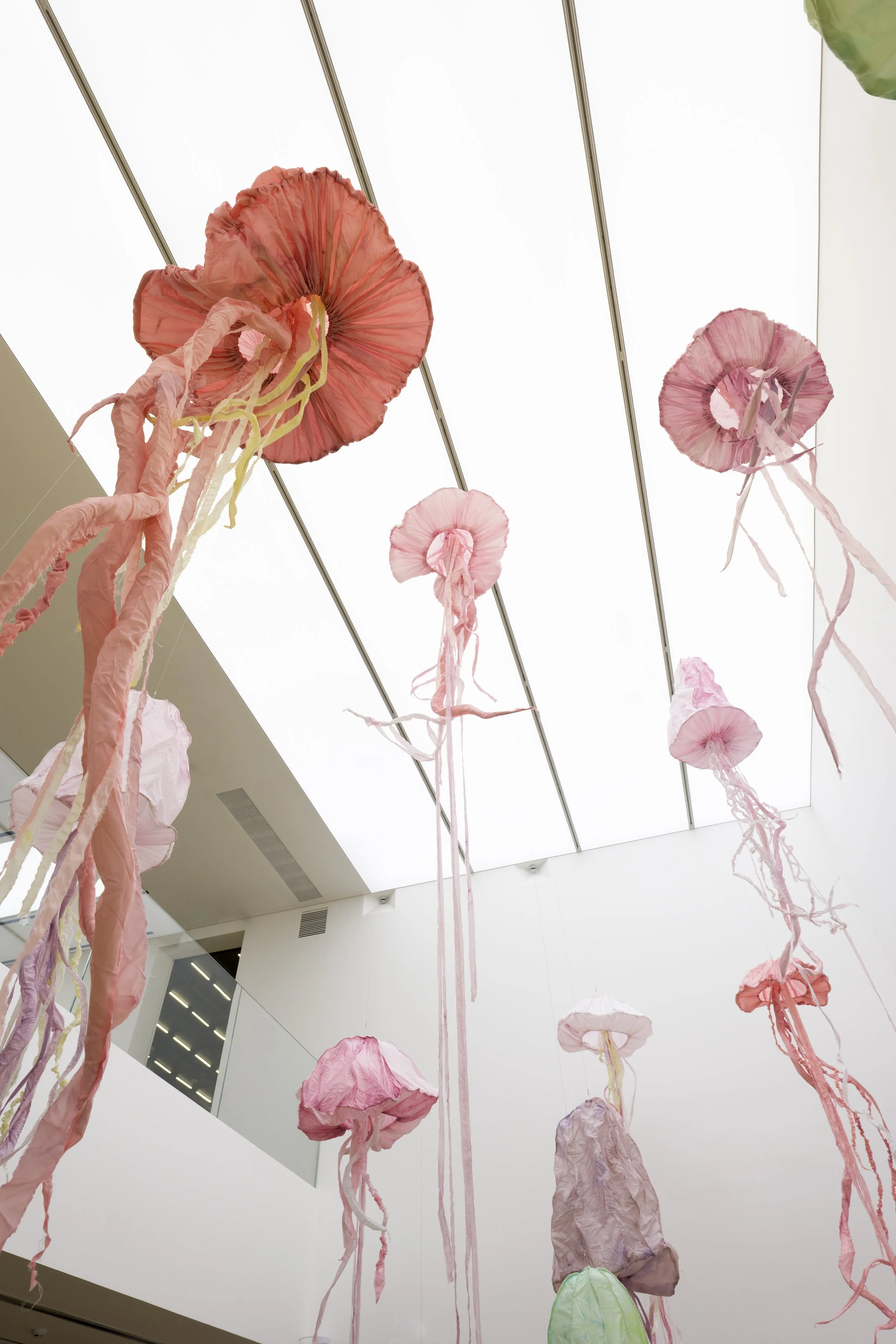
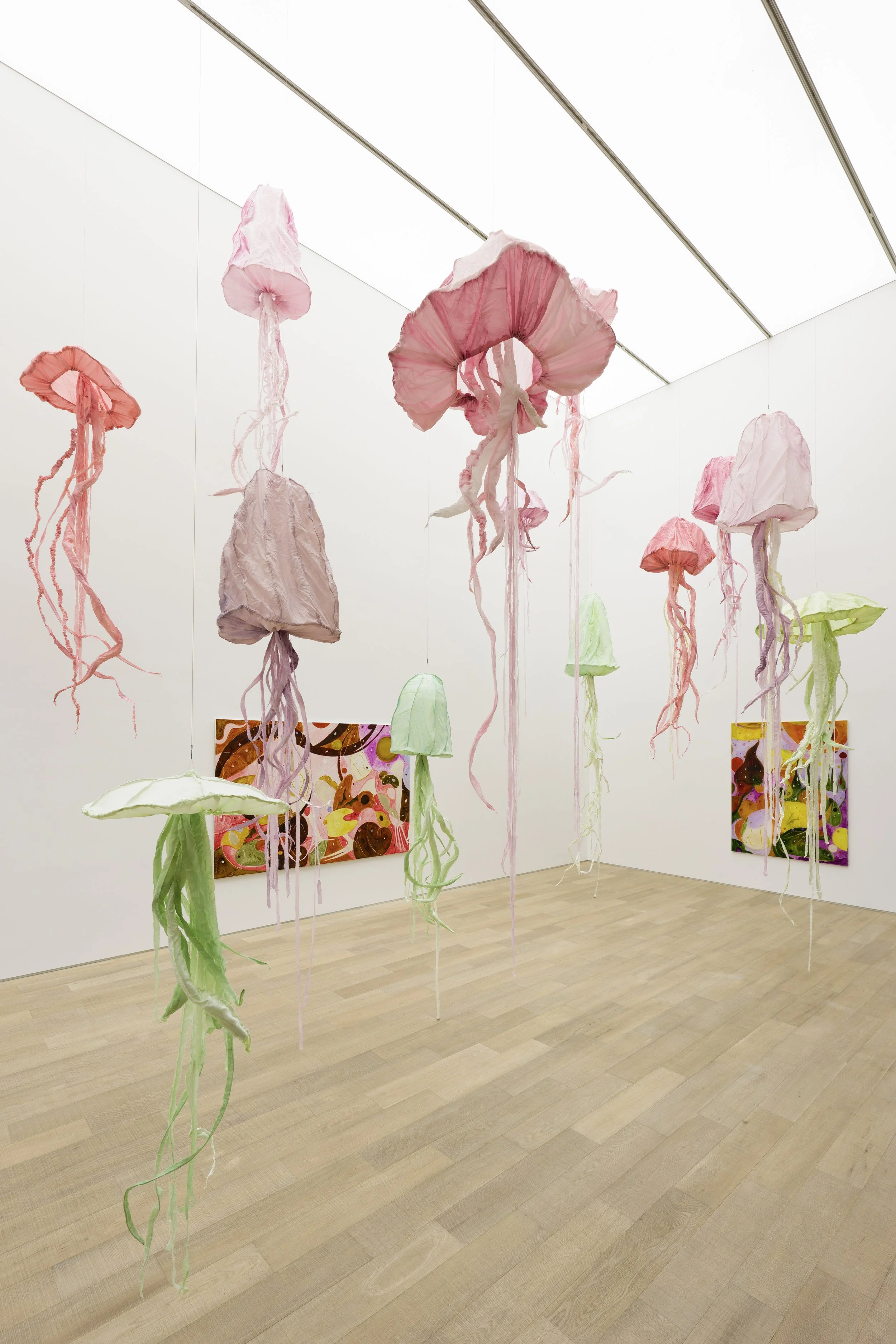
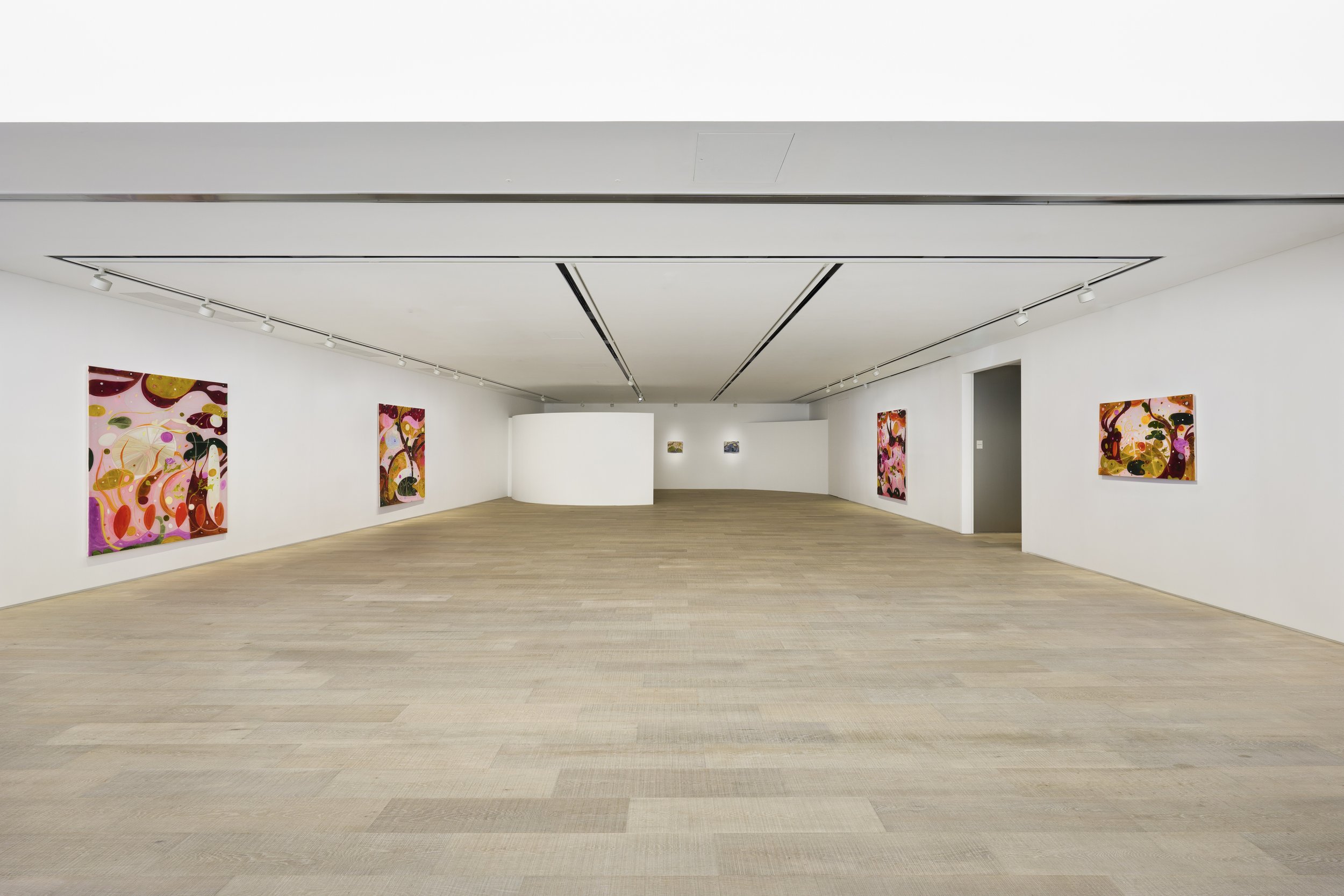
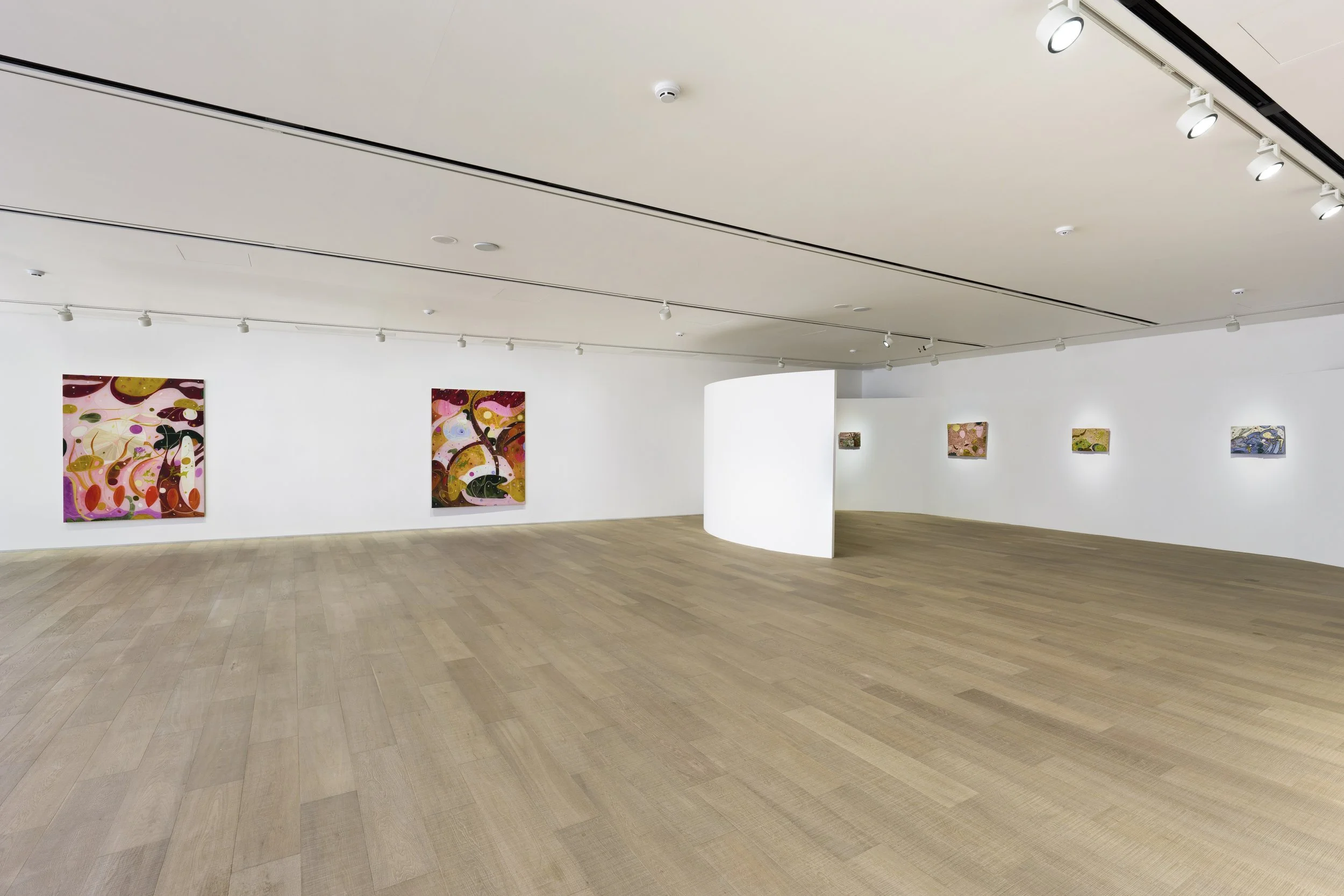
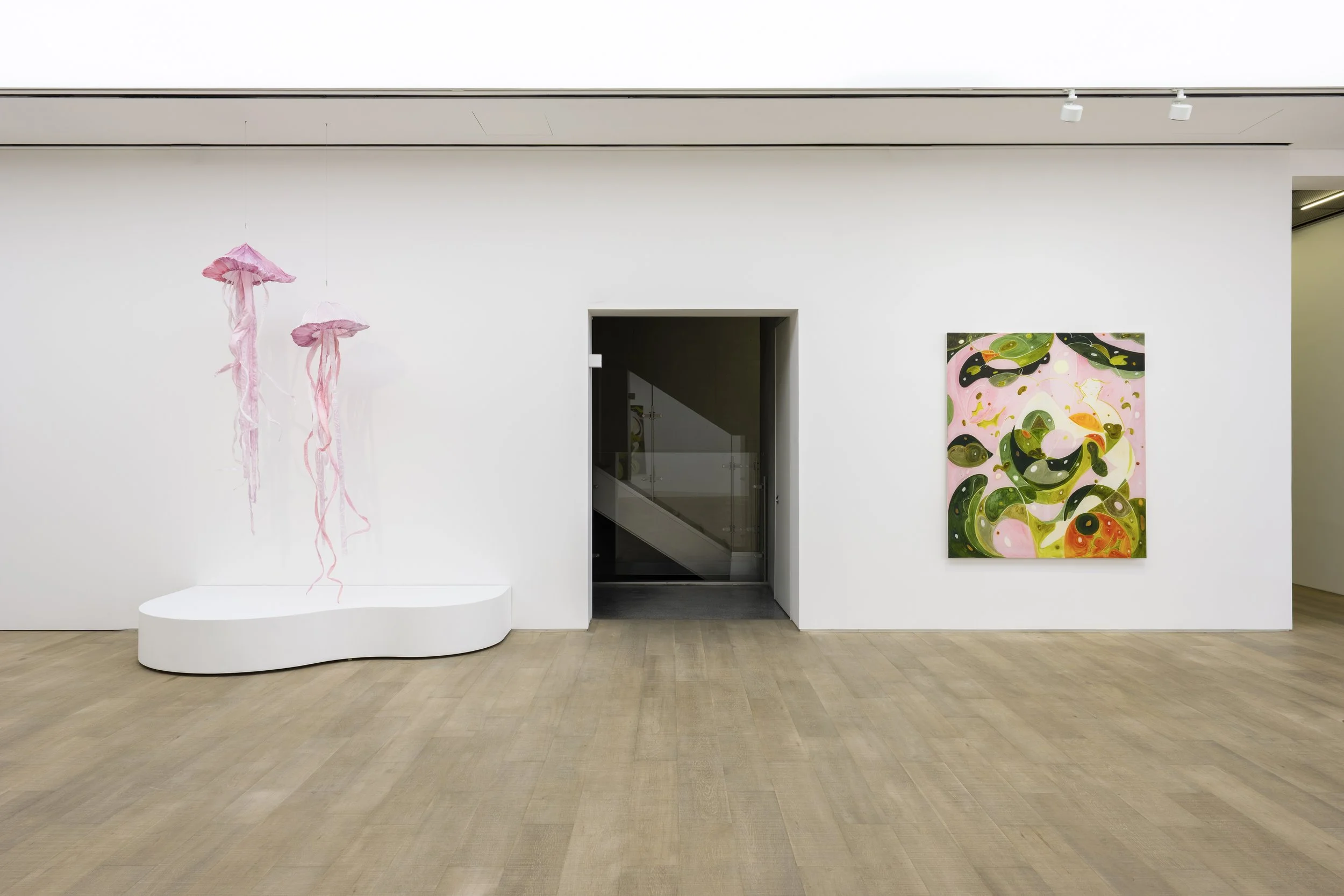
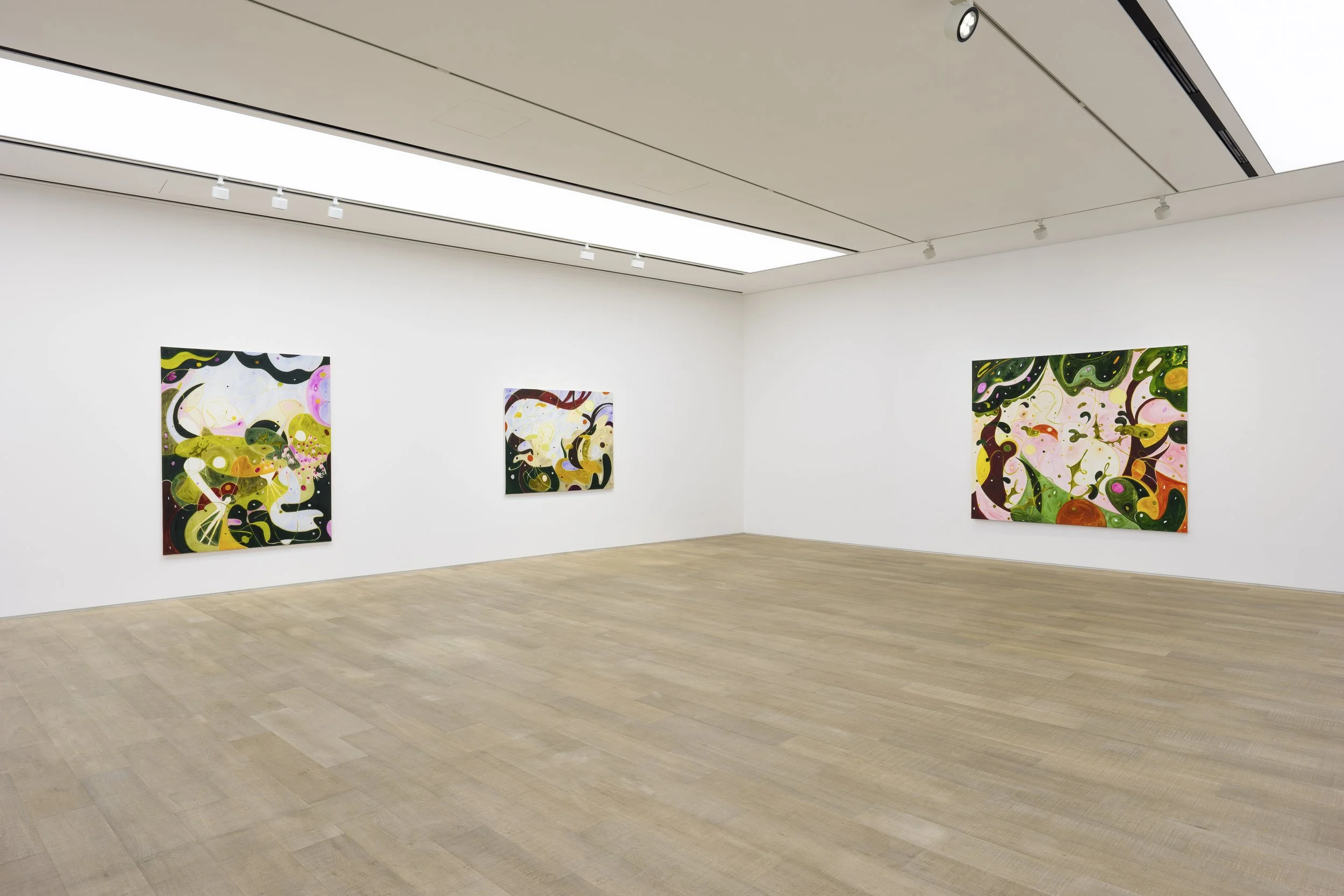
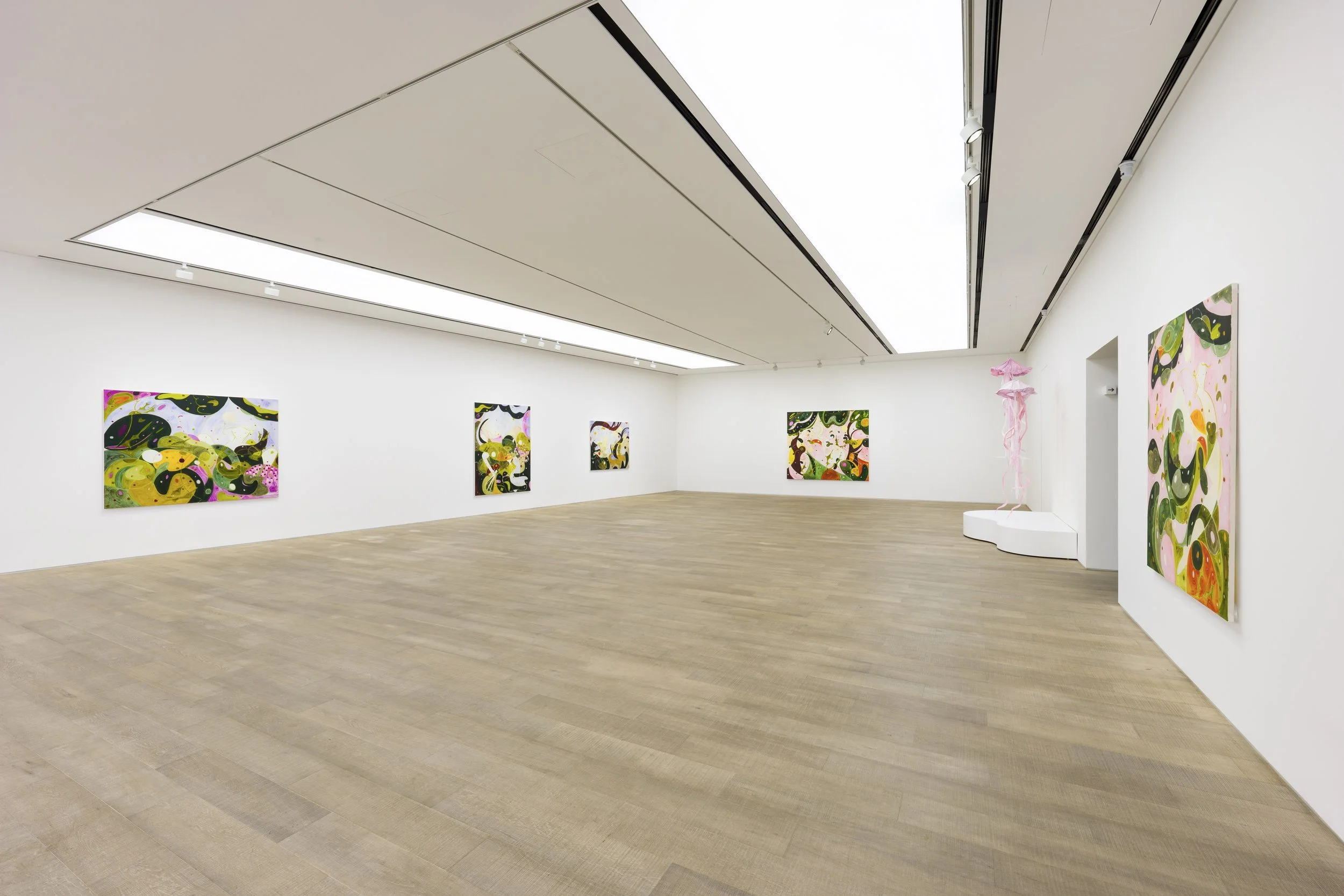
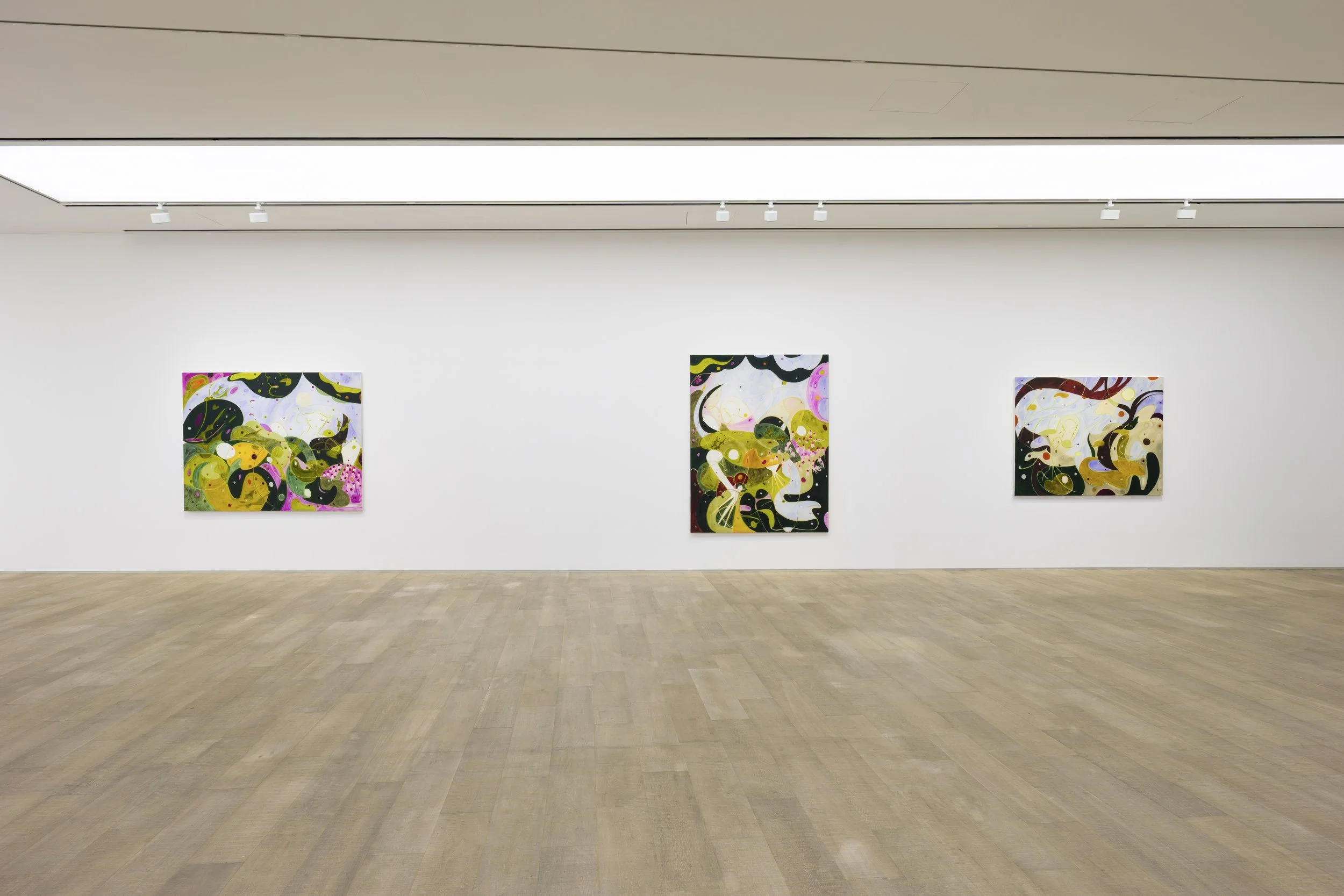
FOUNDRY SEOUL is pleased to present Zero Gravity, a solo exhibition by London-based artist Yulia Iosilzon. This marks the artist’s second exhibition with FOUNDRY SEOUL. Moving beyond the constraints of fixed narratives, Iosilzon constructs a distinctive world of “metamorphosis,” rooted in an exploration of existential conditions, in which materials and symbols continuously intersect and are reconfigured. Symbols and archetypes inherited from diverse histories, cultures, and mythologies recur throughout her practice—across painting, ceramics, and installations—continually transformed through variation as they extend beyond the picture plane into immersive spatial environments. Serving as an extension of the visual narrative the artist has long explored, this exhibition broadens her material vocabulary through the introduction of fabric sculptures while expanding the horizon of her inquiry into ecological and cosmic dimensions.
For this exhibition, Iosilzon envisions a vast ecological landscape in which the boundaries between land, sea, and sky dissolve. Within this environment, distinctions between the human and the nonhuman, the natural and the artificial gradually blur as all forms of existence permeate, connect, and transform one another. Nature no longer appears as a fixed category or symbolic system, but rather as a state of perpetual becoming. Arboreal forms submerged beneath the water acquire the fluid, rhythmic movement of seaweed, while organisms resembling flowers and jellyfish bloom into hybrid beings that oscillate between the botanical and the marine. Here, the landscape no longer functions as a mere backdrop or representation; instead, it becomes an active system—an organic environment that continuously evolves and mutates, inviting viewers to reconsider how nature itself might be understood.
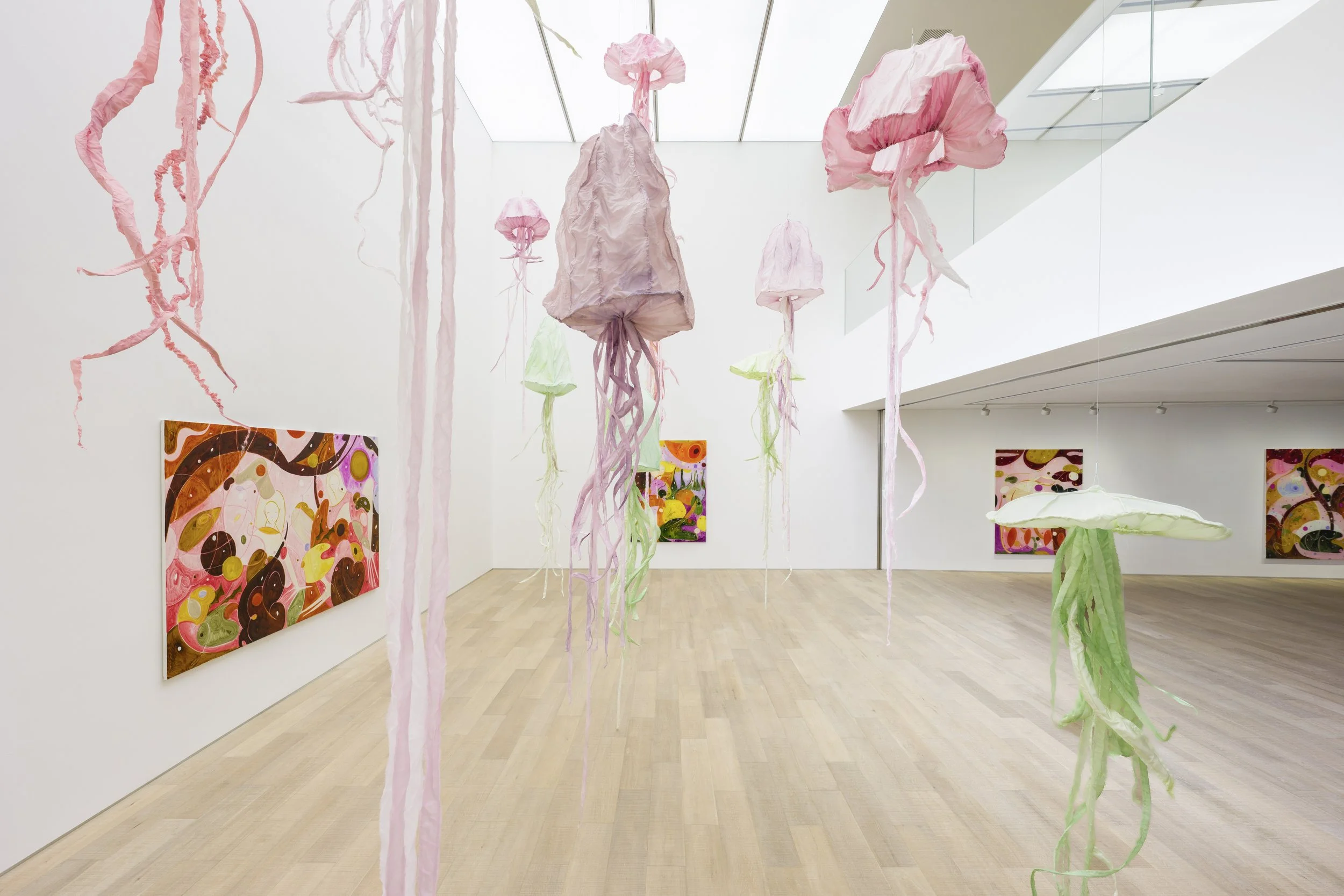
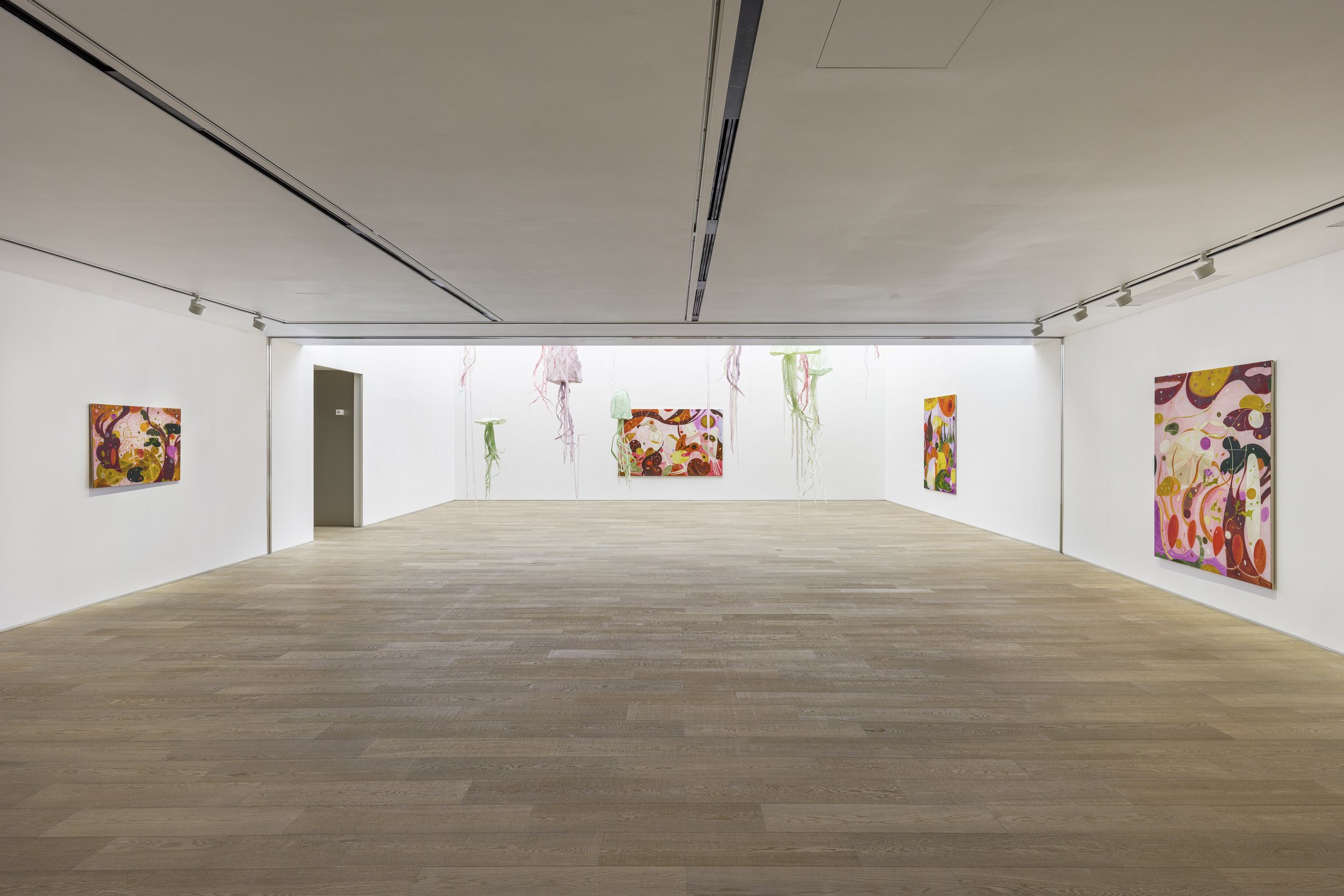
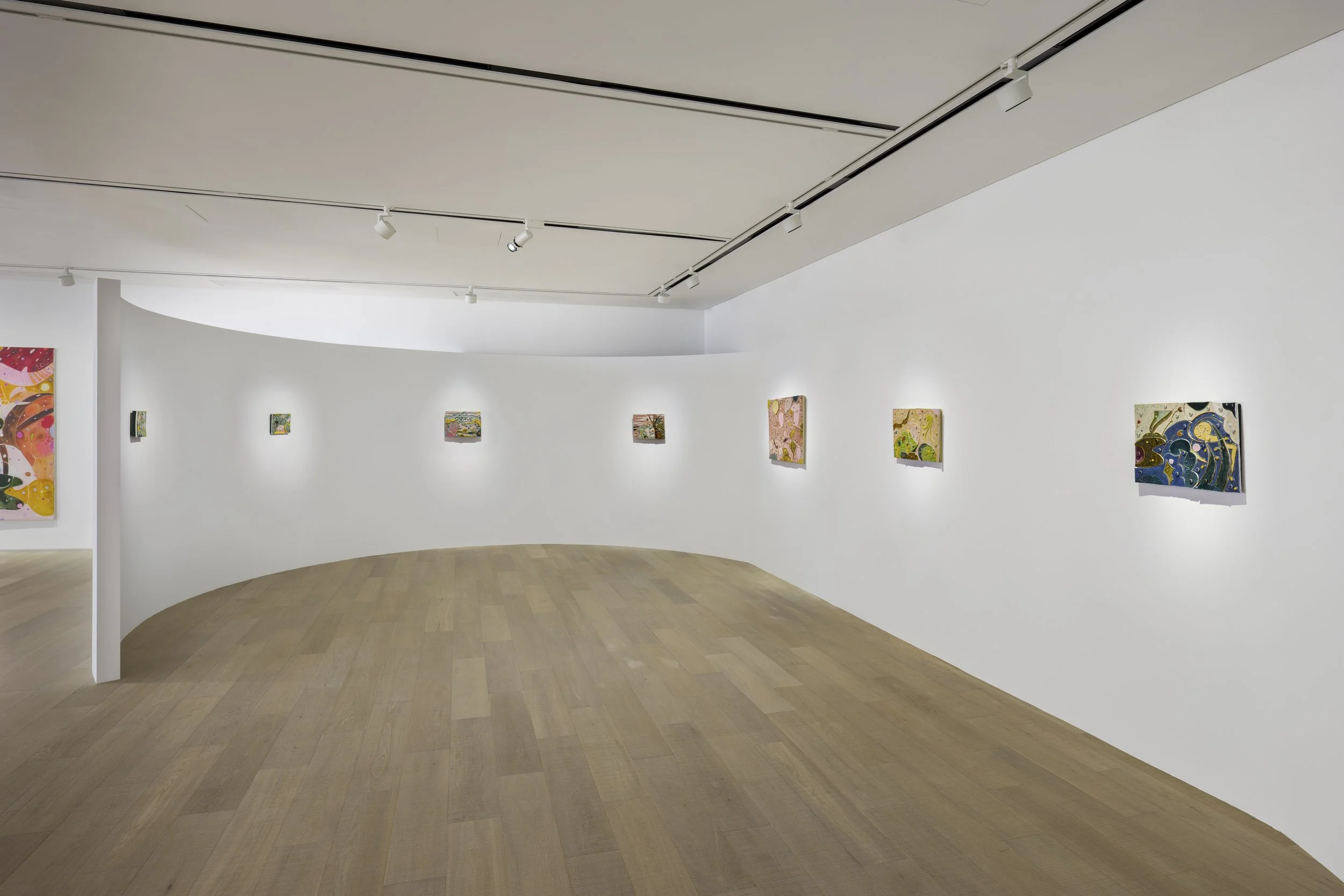
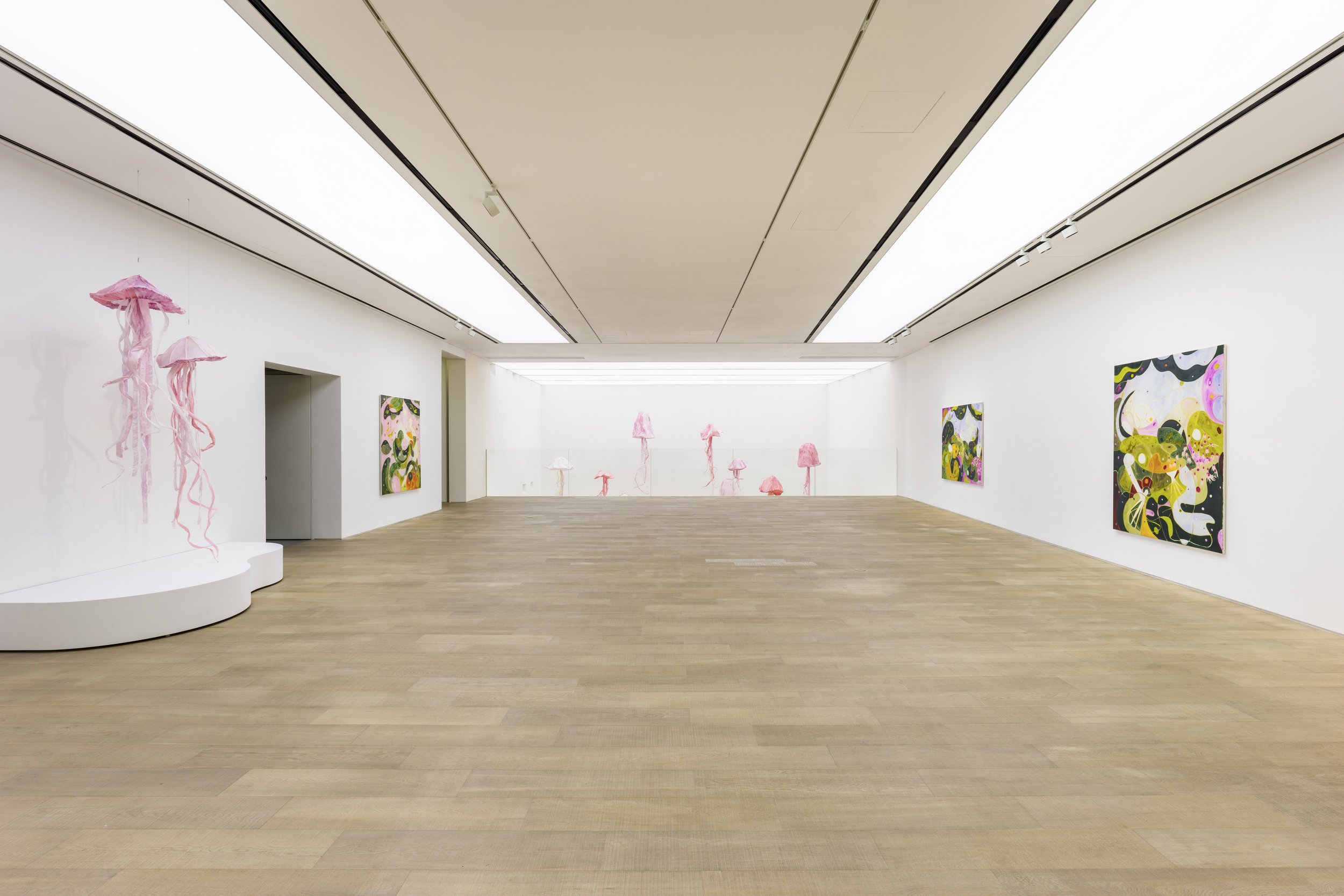
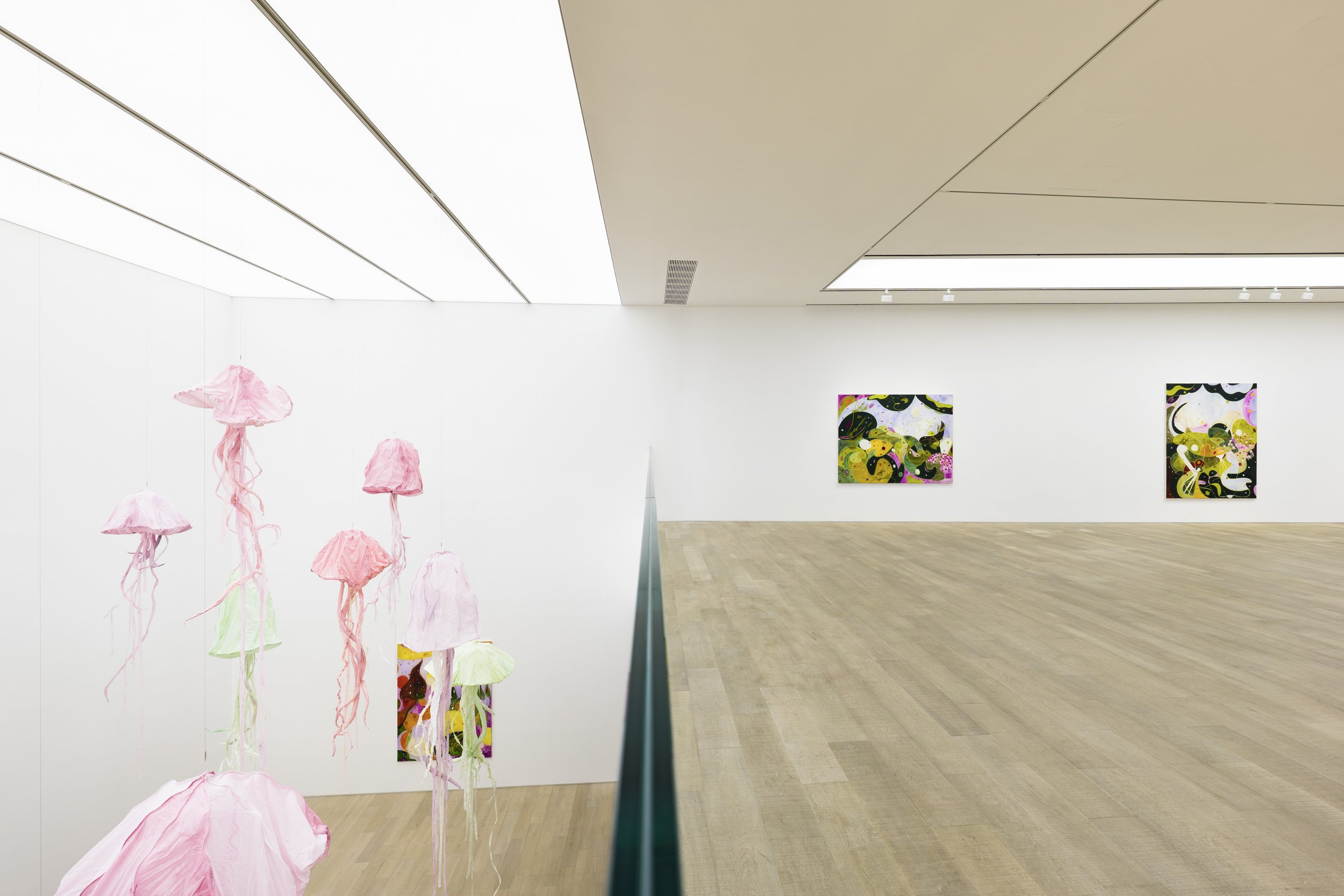
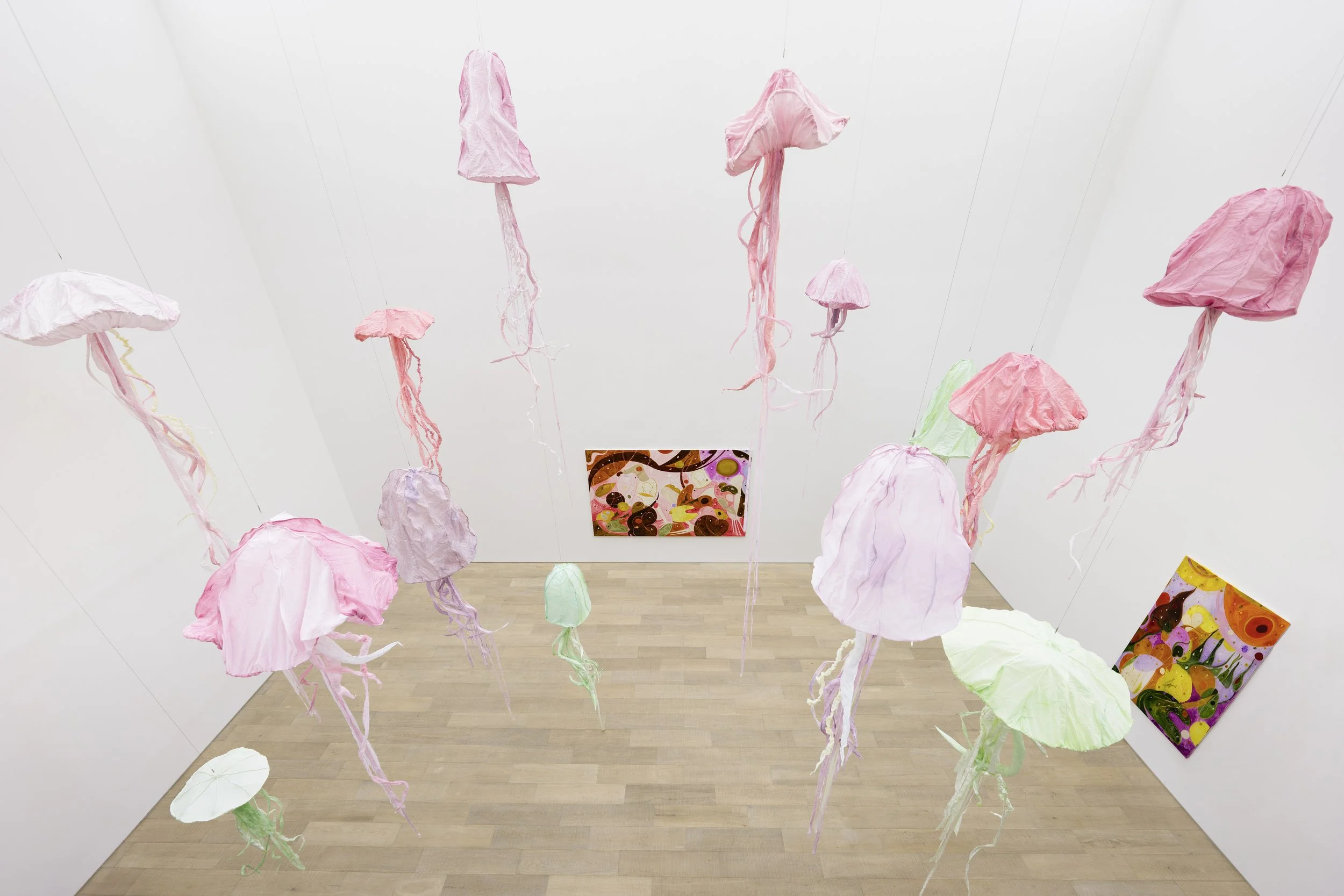
The exhibition space becomes a theatrical stage where Iosilzon’s ever-shifting world comes to life through the movement of the viewer. Spanning two floors, the exhibition unfolds across distinct yet closely interconnected spatial chapters. On the first basement level (B1), translucent canvases layered with delicate lines and colour float alongside smaller fabric sculptures that appear to reflect and respond to one another. On the second basement level (B2), ceramic mosaics crafted from clay settle across the swirling, undulating wall, introducing a more condensed and grounded material presence. While each floor establishes a distinct sensory experience, a unique internal logic, and a narrative rhythm, the two remain interwoven as parts of a larger ecosystem. Linking the two exhibition spaces, the void is occupied by large, suspended fabric sculptures that evoke hybrid life forms traversing the boundary between land and sea. Serving as both a structural and conceptual axis, it becomes a site where suspension and transition coexist. Within this environment, viewers are no longer passive spectators. As they navigate among these hybrid beings, their bodies act as sensory agents, activating this ecosystem while simultaneously becoming part of its living, ever-evolving landscape.
The artist’s exploration of metamorphosis is articulated not only through spatial composition but also through materiality itself. The investigation of materiality remains central to Iosilzon’s practice, and in this exhibition, it unfolds through the interplay of permeability and sedimentation. Translucent fabrics, which recur across different media throughout her work, allow light and air to permeate, dissolving the boundaries between interior and exterior, surface and depth. Evoking skin, atmosphere, and thresholds, they function as permeable membranes that connect different states of being. On the other hand, earthy oil pigments reminiscent of sediment and the mineral glazes applied to the ceramic works lend the imagery a heightened material density. These materials evoke geological time, accumulation, and erosion, revealing the process of transformation in a condensed form. The translucent images floating in the air and the accumulated weight of mineral matter exist in dynamic tension, together generating the sensory rhythm of this ecosystem.
Zero Gravity presents an expansive ecological web where matter and sensation, life forms and ecosystems, and the microscopic and the cosmic are fundamentally intertwined. Adopting a nonlinear structure, this open system shaped by shifting scales, temporalities, and interdependence resists fixed interpretation or narrative resolution. Instead, it unfolds through a fluid stream of experience that is perpetually shifting and dissolving. Here, viewers move through the space, sensing, perceiving, and contemplating, ultimately discovering themselves as part of a vast, interconnected network of existence.
EXHIBITION TEXT
Beauty Is A Surprise - Jennifer Higgie on Yulia Iosilzon’s new works
Vivid colours swirl and eddy; delicate, biomorphic shapes float upwards, entangling with suggestions of trees and flowers, lily ponds, palettes, and branches. Although at first glance these strange and lovely landscapes—which, at times, morph into something aquatic and even galactic—appear to be uninhabited, stay with them, and pale faces appear, conjured in a few swift lines. Like faint spirits, these creatures peer out from the lush foliage and rich constellations of this kaleidoscopic realm with a look of delicate enquiry. Gravity, here, is untethered; only the limpid blue sky, radiant above the sinuous landscape, indicates which way is up. Chaos, however, is subsumed into a mood of light-hearted joy.
When Yulia Iosilzon was creating her new oil paintings and ceramics, she kept a postcard close by. It was Sables au bord de la Loire (Sands of the Loire, 1923) by the Swiss-French artist Félix Vallotton. It’s a simple, strange, psychologically charged landscape in which sand dunes on the banks of a river evoke the fleshy legs and buttocks of a naked woman. The green trees are bulbous and soft; a diminutive blue boat is reflected in the limpid water. The slight figure of a man is inconsequential against the voluptuous beauty of the landscape. Although it’s a seemingly straightforward picture, Iosilzon was captivated by its ambiguous symbolism. It’s an approach to artmaking that, she says, she’s gravitating towards more and more.[1] She is also drawn to the “freshness” of Vallotton’s palette, the dreamlike atmosphere he conjures with the lightest of touches; his recurring fascination with shadows, use of crimson red, and what Iosilzon describes as his “sense of order.”
In recent months, the artist has been pushing back against her natural instinct for order, allowing her unconscious to roam where it will. Previously, she made sketches to prepare for a painting, but for this new body of work, aiming for greater spontaneity and mining what she calls her “free will,” she challenged herself to conjure images without necessarily knowing what the outcome might be. She wanted her new paintings to embody both the energy of a sketch and the intensity of music. Iosilzon explains: “Once the rhythm of a painting is established, it allows you to keep painting.”
To see a group of Iosilzon’s paintings together is to be immersed in something lyrical: biomorphic shapes in vivid colours—dusty pinks, warm sap greens, myriad variations on sunny yellows, burnt oranges, and hot reds—pulsate across the surface, like notes of music, drunk on champagne. The artist’s fascination with the sound of her pictures is, of course, part of a long artistic tradition, from James Whistler’s “Symphonies,” to Wassily Kandinsky’s “Improvisations” and Paul Klee’s “polyphony”; later, abstract expressionists such as Willem de Kooning claimed he “bent” paint in the same way a musician bends the notes in a song. Joan Mitchell was also obsessed with the sonic aspect of painting: she listened to classical music and jazz while she painted, transforming melodies and rhythms into an array of gorgeous, gestural marks that dance their way across the surface.
Iosilzon’s influences are eclectic. Along with the many artists already discussed, she mentions Arthur Rackham’s illustrated children’s books—she’s fascinated by universal stories and their connection to Greek myth—and the Swiss painter Miriam Cahn’s great ability to evoke strong, often frightening, emotions with the most economical of gestures. She also cites the ceramic artist Betty Woodman, along with the sculptors Eva Hesse and Erwin Wurm, as inspirations: she loves, in particular, their playfulness. In recent years, Iosilzon has also been drawn to the paintings of the Swedish mystic Hilma af Klint, who long mined the symbolic power of vegetal forms and whose works, says Iosilzon, inhabit a “very comforting room in my head.” She describes af Klint as “the queen of symbolism and the queen of pigments” and returns to her paintings and drawings “like an old friend.” She’s been particularly fascinated by the cyclical and pulsating nature of af Klint’s compositions, the often calligraphic quality of her lines, and idiosyncratic use of colour—in particular purples and pinks, both of which carried symbolic meaning: “pink represented spiritual love and purple (or violet) represented the wisdom, peace, and softer energy associated with the final stages of life.”[2]
In Iosilzon’s recent work, which she’s exhibiting under the collective title Zero Gravity / 무중력, her assorted explorations have come together in a riot of colour and line punctuated by the recurring motif of the wraithlike witnesses, which pull the compositions back from pure abstraction into a trippy kind of figuration. I ask Iosilzon who, or what, these creatures are. She replies: “They’re usually female characters. And what they represent depends on the painting. In some works they act like anchors in a hallucinogenic world.” In The Bathers (all works 2026), two slight, bald heads gaze out from a maelstrom of thin pink lines, which tumble and weave their way across the warm-toned, mosaic-like painting, pulling together palettes and plants, the night sea and the deep sea. In The Story of Medusas and Their Companion, what might be an underwater kingdom is inhabited by a tiny, white, four-legged creature whose face echoes the two in The Bathers. While some of these new works are oil on linen, others, such as Training Curiosity, are painted on a more translucent fabric. It lends the image an otherworldly atmosphere: what might be spinning orange planets hover over a bright yellow ground, above which drifts a hot pink, bean-like shape. In the upper left-hand corner, a wide-eyed creature hitches a ride on a contorted moonbeam.
If the paintings lean towards ephemerality, Iosilzon’s ceramic works, by contrast, bring the imagined ecology down to earth: shaped pieces, their glazes rich, deep, and often mottled, come together like a cosmic jigsaw. In the underwater scene Close to the Shore Vol. II, for example, a lone character peers into a fishy universe populated by medusas, whose tentacles curl upwards, like a ballerina’s hands. The painted realm is translated into an object: buoyant motifs become earthbound as jewel-like fragments. Iosilzon draws an analogy between the unpredictability of paint—a quality that both challenges and inspires her—and the volatility of ceramic glazes. She describes opening her kiln after firing the shapes that will constitute a ceramic work as “a pure joy of surprises … a full bucket of surprises!”
The swirling sense of a centrifugal force in Iosilzon’s work evokes the cyclical qualities of the earth, the sea, and the skies. She has frequently included sculptures of diverse life forms alongside her paintings and ceramic works. After she gave birth to her son a few years ago, she became fixated on snails: she discovered that across various cultures, their spiral shells—a form of protection and home—have long been a symbol not only of motherhood but of fertility, new life, and cycles of birth and rebirth. For her new exhibition, Iosilzon has created a series of large yellow and pink jellyfish, which will hang from the gallery’s ceiling: she likes their ambiguity—they recall both mushrooms and figs, silk parachutes and the Taj Mahal—and the way they hover, suspended between the so-called real world and the world of dreams, indifferent to gravity. The artist is also drawn to their connection to Greek mythology: commonly known as “medusa” because the shape of their bodies and long tentacles recall the hair of the mythological monster of the same name, whose head was depicted covered in writhing snakes.
Colour is deeply important to Iosilzon. She always uses oil paint as she believes the pigments are more intense than those in acrylics, and she loves how “every tube is different.” She mentions the names of the paints she loves like a poet lingering over beloved words: Alizarin Claret; Kraplak Rose Antique Extra; Cobalt Violet.
When talking about painting, Iosilzon often uses gardening analogies. Speaking about this new body of work, she explains that her earlier paintings and ceramics scattered the seeds that bloomed into something new. It’s apt, then, that the motif that is central to her thinking is that of a tree, especially oak trees. She’s fascinated by the fact that they’re often depicted as magical, but are also everywhere in the landscape. In numerous cultures, they represent the cycles of life and are home to numerous creatures. In many ways, Iosilzon attempts to mimic nature’s approach to creation: more than anything, she wants her images to grow organically. She explains that she’s happy when “beauty just happens.” She elaborates, “Beauty is a surprise and it shouldn’t be planned. It should spark joy.”
[1] All quotes from the author’s visit to Iosilzon’s London studio, 26 June 2026.
[2] Leda Scully, “Understanding Hilma. A life dedicated to spirituality in art,” Irish Museum of Modern Art, 24 August 2017, https://imma.ie/magazine/understanding-hilma-a-life-dedicated-to-spirituality-in-art.